
Complicit Curatorship: Benin Bronzes, Western Museum Displays and Colonial Narratives (Dr Joseph Yu)
Museums are important anthropological sites as they play a powerful role in shaping identity of people through constructing knowledge and representing materials culture. Especially in postcolonial contexts, the ways in which museums classify, describe and display objects can reinforce particular worldviews. Museum displays are therefore far from neutral; they are embedded in historical and political power relations. As western museums continue to decolonise, objects acquired during conquests and colonial rule such as the Benin Bronzes are among the most contested in debates about colonialism, representation and repatriation. This project seeks to recontextualise the Benin Bronzes by placing them in the ethnographic context of the Edo people in Benin.
Produced from around the 13th century in the Kingdom of Benin (nowadays Nigeria), the Benin Bronzes are a group of brass and bronze sculptures and ritual objects. These objects, often associated with the royal court of the Oba (ruler), were created by Edo artisans using sophisticated casting techniques. They were used primarily in palace and ritual contexts rather than as decorative art. In 1897, many of these objects were forcefully removed during a British expedition. The Benin Bronzes were later dispersed into museums and private collections across Europe and North America. According to Ben-Amos (1980), the bronzes once functioned as part of a wider system of ancestral worshipping, political authority and historical memory creation centred on the Oba. Yet, in western museums their rich cultural meaning are often flattened when portrayed as ‘art objects’ in a western sense, with their social, political and spiritual contexts ignored. How far could we see this as a continuation of cultural imperialism?
To understand this question adequately, we must turn to Clifford and Said. In his monography, Clifford (1988) argues that through processes of selection, display, and interpretation, museums operate within an “art–culture system” that encourages the reclassification of cultural materials as art. In this process, objects are decontextualised from their original social environment and reinterpreted in Western understanding that priories the ‘ocular’ aesthetic value and institutional interpretations
This essay will first outline the ethnographic context of Edo society and the cultural significance of the Bronzes. It will then move on to analysing primary data from online museum collections from the British Museum. Museum displays, including display labels, gallery placement, and collection categorisation, can be seen as cultural texts that reflect institutional priorities and frameworks. They communicate implicit assumptions about culture, history, and authority. As such, this essay treats museum interpretation itself as a form of secondary ethnographic data Lastly, the essay will synthesise findings using the anthropological theory of James Clifford. Overall, this essay argues that if seen as works of art, Western museum displays of Benin Bronzes to a large extent perpetuate colonial representations of African material culture, although most have started recontextualising the bronzes in their original cultural contexts.
Ethnographic Context of the Benin Bronzes
Material culture is central to the maintenance of different cultures in the world. In addition to signifying cultural distinction and sometimes generating cultural stereotypes, objects also have prodigious impacts in identity and memory processes. To understand the Benin Bronzes fully, we must investigate into their ethnographic context. Anthropological research on the Edo people of the Kingdom of Benin shows that rather than being produced as works of art, Benin Bronzes functioned as their creators’ material expressions of social hierarchy and worldview. They were deeply embedded within a complex cultural system linking ritual, political authority and historical memory. Thus, the meaning of the Bronzes were severely disrupted and altered when they were removed from the Edo society and re-represented in western museums.
Developed from around the thirteenth century, Benin’s social and political system stemmed from the authority of the divine king ‘Oba’. To the Edo people, their Oba was not merely a political ruler; he was a sacred figure, a living mediator between ritual, ancestry and spiritual mediation (Ben-Amos, 1980). Under the Oba, the Edo society was centralised and hierarchical, dominated by court officials, titled chiefs, guilds of specialists and ritual practitioners (Dark, 1973). Edo people used material culture not as passive decorations but as active participants in social life to mediate relationships between humans, spirits and historical lineages. As Ben-Amos (1980) emphasises, Edo visual culture is part of a broader communicative system through which power was legitimised and thus sustained.
Edo material culture was essential in the maintenance of their social system. For example, the Bronzes were part of royal ancestral altars which commemorated former Obas, where ritual offerings were made in return for the spiritual protection of Benin. Bronze heads, together with ivory tusks, plaques among other objects, would have been arranged in specific configurations to convey symbolic meaning (Ben-Amos 1980). For example, crocodiles (See Figure 1) for the Ebo people equated to ‘policeman of the waters’, which symbolise the Oba’s authority to punish wrongdoers. Similarly, pythons (see Figure 2) were seen as king of snakes, and the messenger of the god Olokun, connecting the Oba to spirituality. Instead of functioning as portraits in a western realist, artistic sense, bronze heads represented idealised forms of both kingship and kinship. The use of durable materials to construct these objects show how they were intended to embody not just authority and spiritual potency, but more importantly the ideas of permanence and dynastic stability (Dark, 1973). In such way, meaning emerged relationally through ritual practice, which would have been lost when viewed in isolation. The production of the Bronzes was itself a socially regulated process within the Edo political mechanism, as artisans belonged to hereditary guilds that relied on successive Obas’ patronage. With technical knowledge passed down generationally, these artisans were court specialists whose work was dictated by ritual and political requirements (Ben-Amos, 1980). This highlights how authorship and creative were collective rather than individual. It follows that objects gained meaning through their role in sustaining social cohesion and reinforcing shared historical narratives. Thus, separating these objects form their production context risks obscuring their ethnographical relationship that originally afforded them meaning.

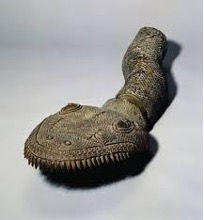
Figures 1 and 2. Benin Bronzes depicted animals such as crocodiles (top) and pythons (bottom).
Secondary to their ritual function, many Bronzes, especially plaques, served as visual records of court life, ceremonies, and encounters with foreign visitors. The Edo people had no writing system until the arrival of European latinised their language, so as a group they relied particularly on oral traditions and material culture to pass down historical memory. By controlling the production of Bronzes, the Edo elite were able to construct their own narratives of power and legitimacy. For example, Bronzes might show attendants, showing the Obas’ wealth and power in the kingdom (see Figure 1). Created from an Edo perspective, these representations were intended for internal audiences familiar with the Benin court’s symbolic language. For instance, by featuring the Oba wearing ‘mudfish belts’, the brass plaque (see Figure 2) symbolise king’s authority over both land and sea, as the mudfish hops in and out of the water in the coastal swamps and are at home on land as well as in the sea. Furthermore, by portraying the Oba holding leopards in his hands, the plaque draws parallel between the Oba’s unchallenged authority in Benin and the leopard’s status as ‘king of the forest’. Indeed, the Oba used to keep leopards as pets, which were paraded on important occasions like mascots (Dark, 1973).This challenges the western categorisation of the Bronzes as ‘artwork’ detached from time and function: they are active agents in meaning-making processes that linked past, present and future.
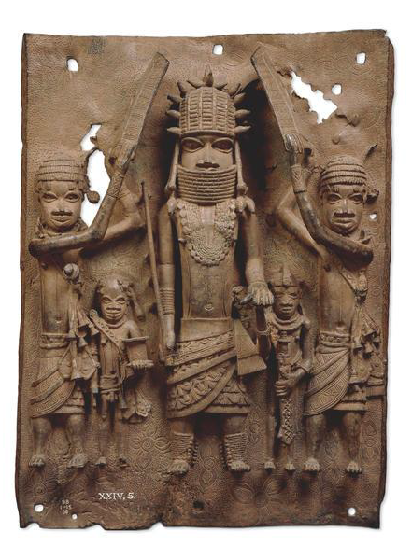
Figure 3. Brass plaque showing the Oba of Benin with attendants (Benin, Nigeria, c. 16th century AD).

Figure 4. Brass plaque of the Oba holding leopards and wearing a mud-fish belt (Benin, Nigeria, c. 16th century AD)
Through their continued use in ritual contexts, the bronzes afforded the unity of kingdom and the continuity of Edo identity across generations (Ben-Amos, 1980). This shows how meaning was not inherent in the object itself but produced through engagement with people, ritual repetition and shared knowledge. Part of its function was to reinforce shared values, cosmology and social hierarchies, which sharped contrasted with how museum encouraged visitors to visually consume the Bronzes without giving meaningful context of the cultural systems from which they originate (see Figures 3-4). To begin with, their removal from ancestral altars and court spaces into privatised collections had already disrupted the networks of meaning through which they once operated. Worse, as will be discussed later, western museums repeatedly portray Bronzes as examples of African or even world art, which risks marginalising the relational, ritual and political dimensions of the Bronzes.


Figures 3-4. Benin Bronzes, decontextualised and displayed as works of art at the British Museum (top) and Metropolitan Museum of Art (bottom).
Museum Display Analysis: Western Presentations of the Benin Bronzes
The British Museum houses one of the largest collections of Benin Bronzes due to the British punitive expedition of 1897, when over 900 objects acquired directly or indirectly. Despite restitution efforts, around fifty to sixty plaques are still displayed in a grid-like formation against a wall at the Sainsbury Africa Gallery. This selective presentation influences visitor understanding on the scale of looting and the Bronzes’ cultural significance. To begin with, the plaques appear to “float in front of a wall,” with subtle lighting that heightens their visual impact while simultaneously distancing them from their original palace setting in Benin City (Phillips, 2021, pp. 21–22). This display method isolates individual heads and plaques, which invites aesthetic appreciation rather than contextual understanding. Although this display method mimic how the plaques once decorated the palace pillars of Benin, its effectiveness is limited by the lack of architectural reconstruction or ritual context (such as in the Greek galleries of British Museum). By arranging the plaques vertically like a wall, the Bronzes are presented as a single “monumental corpus … to convey political authority, historical continuity, and cosmological order” (Gunsch, 2020, p. 32).
Previously, indigenous peoples were exhibited and categorised from a biased colonial perspective and were denied agency in their own representation. While the central questions of how to decolonise and how far should decolonising go in museums remain topics of debate (Onciul 2015, p. 170), two major decolonising approaches can be identified. This includes indigenisation of space and methodology (Rangel 2012, p. 44) and telling the ‘hard truths’ of colonial atrocities and legacies honestly and explicitly (Lonetree 2009, p. 326). The British Museum’s caption labels shows the latter as it acknowledges colonial violence and retraces the journey of the Bronzes as part of British imperial exploitation. On the left hand side of the Bronzes is a prominent panel titled “Benin: colonial conquest and military looting”, which describes the 1897 expedition as “violent and devastating,” noting that objects were plundered from palaces and shrines and that Oba Ovonramwen was deposed. However, with phrases such as “objects were plundered”, its language remains very passive. It seems to obscure agency, dilute British responsibility and frames looting as an unfortunate historical outcome rather than a deliberate act of violence (McEwen 2021). This perspective contrasts sharply with historical and anthropological accounts of the British expedition. In his latest book Brutish Museum, Hicks characterises the attack on Benin City as a “crime against humanity,” as it involves mass killings by 1200 armed marines, the destruction of a royal and religious centre, as well as systematic looting (Hicks, 2020, pp. 113–114; McEwen, 2021). The museum label also describes the initial British mission as “provocative”, which similarly minimises the structural violence of imperial expansion and regime change their action caused. Worse, the display does not adequately convey the sheer scale of cultural loss. While the label references “nearly 1000 brass plaques,” only fifty-six are shown together. Dispersed across the gallery in sections as testaments to Benin’s superior metal casting or iconography, the other Benin objects are left without reference to the 1897 looting. This arrangement risks leading visitors to underestimate the extent of disruption caused by British actions and reinforces what Hicks describes as a form of institutional denial, in which “violence is acknowledged abstractly but neutralised through curatorial practice” (Hicks, 2020, p. 231).
To further illustrate the continued colonial representation of African material culture, we need to turn to specific iconic objects. For example, placed behind perplex glass and praised for its technical refinement and symbolism, the Bronze Head of Queen Idia (Figure 5, Af1897,1011.1) is displayed as a masterpiece of African art, decontextualised from its original, primary role as part of Edo ancestral worshipping. The museum catalogue currently categorises it as a “African art”, a “commemorative head,” and, instead of discussing its cultural significance, highlights the technical sophistication of lost-wax casting, and describes the coral-beaded headdress and facial markings in detail (British Museum, 2025). The exhibition label in the gallery encourages visitors to view it from an art history perspective. The context of acquisition is separated from the primary descriptive text, although the Museum does acknowledge the head was taken during the 1897 British punitive expedition in a separate label. This is only explained in other gallery panels rather than directly tied to the object itself, meaning that visitors can potentially miss out on the important context. At best, even if visitors understood the violent roots of the acquisition, such circumstances are not foregrounded in the immediate encounter between viewer and object. With the limited explanation on the Queen political role as Iyoba (Queen Mother), and how the Bronze head would have been displayed prominently on royal ancestral altars, visitors would fail to engage with it as a ritual object embedded in Edo cosmology and political symbolism. Furthermore, the Museum ignores how the Queen still has emotional significance for Edo decedents: for example, a Nigerian visitor described the experience of seeing the Queen’s head in the British Museum as “visiting a relative behind bars” (Phillips, 2021, p. 25). This is a result of the museum’s alienation of cultural context; a perspective entirely absent from the museum’s interpretive framework whether it is exhibition texts or display arrangement.


Figures 5-6. Queen Idia’s head (top) and Bronze Cockerel (bottom).[1]
Another iconic object is the bronze sculpture of a cockerel (Af1898,1025.1-2) displayed in the British Museum, which was originally looted during the 1897 British Expedition to Benin. On British Museum’s online catalogue, the early, colonial catalogue by Read and Dalton (1899) is still available to the public. Described primarily in terms of its “naturalistic modelling” and decorative qualities, the entry did not acknowledge its ritual and symbolic significance within the Edo court. This shows how the museum continues to “shoehorn the stylised Benin figures into the precepts of naturalism,” which privileges European ‘taste’ over indigenous meanings (Gunsch, 2020, p.166), thereby perpetuating colonial representation of African material culture. Similarly, by placing the cockerel in a ‘sanitised’ glass display case, the Museum isolates the material culture from its original monumental and ceremonial ethnological context. By taking it out of use, its original royal symbolism that was dynamic and accumulative was denied; a static and aesthetic representation were instead emphasised. This shows that such displays in the British Museum are not neutral but part of a “white projection” that legitimised looting and recast sacred regalia as art objects for Western consumption (Hicks, pp.198–207).
Lastly, the museum also makes very limited reference to repatriation claims. The label only mentions the Benin Dialogue Group and collaboration with Nigerian partners, but not the repeated and longstanding demands by Nigerian authorities for the return of the bronzes, reflecting their outdated bureaucratic mindset that frames retention as legality and repatriation as risk, despite the clearly violent origins of acquisition (Hicks, 2020, pp. 198–199). The museum’s display of the bronzes, even with recently reworded labels in response to calls for further decolonisation, continues colonial authority. While the British Museum has taken steps toward greater transparency, its spatial language of the Benin Bronzes gallery continues to prioritise the ocular, aesthetic appreciation over ethnographic meaning and African perspectives. The museum reproduces colonial representational frameworks through selective display, passive language, and limited engagement with repatriation. As a result, the bronzes remain detached from Edo cultural systems, which helped the British to continue to reassert their control over interpretation.
The Metropolitan Museum of Art
Similarly, with their strong trade collection with and cultural connection to the British Empire in the 19th century, the Metropolitan Museum of Art (the Met) in New York also has an important collection of Benin Bronzes. Unlike the British Museum’s denser and more fragmented display, a smaller number of Bronzes are displayed within the Michael C. Rockefeller Wing, which is dedicated to the arts of Africa, Oceania, and the Americas. Although the exhibition labels on site, similar to the British Museum, are relatively brief, the Met’s online catalogue features extensive object labels and curatorial texts entries. In addition to artistic descriptions, these entries detail the Bronzes’ historical context and courtly function, leading to its more successful attempt in presenting Benin works as products of a complex and centralised state rather than as isolated ethnographic specimens.


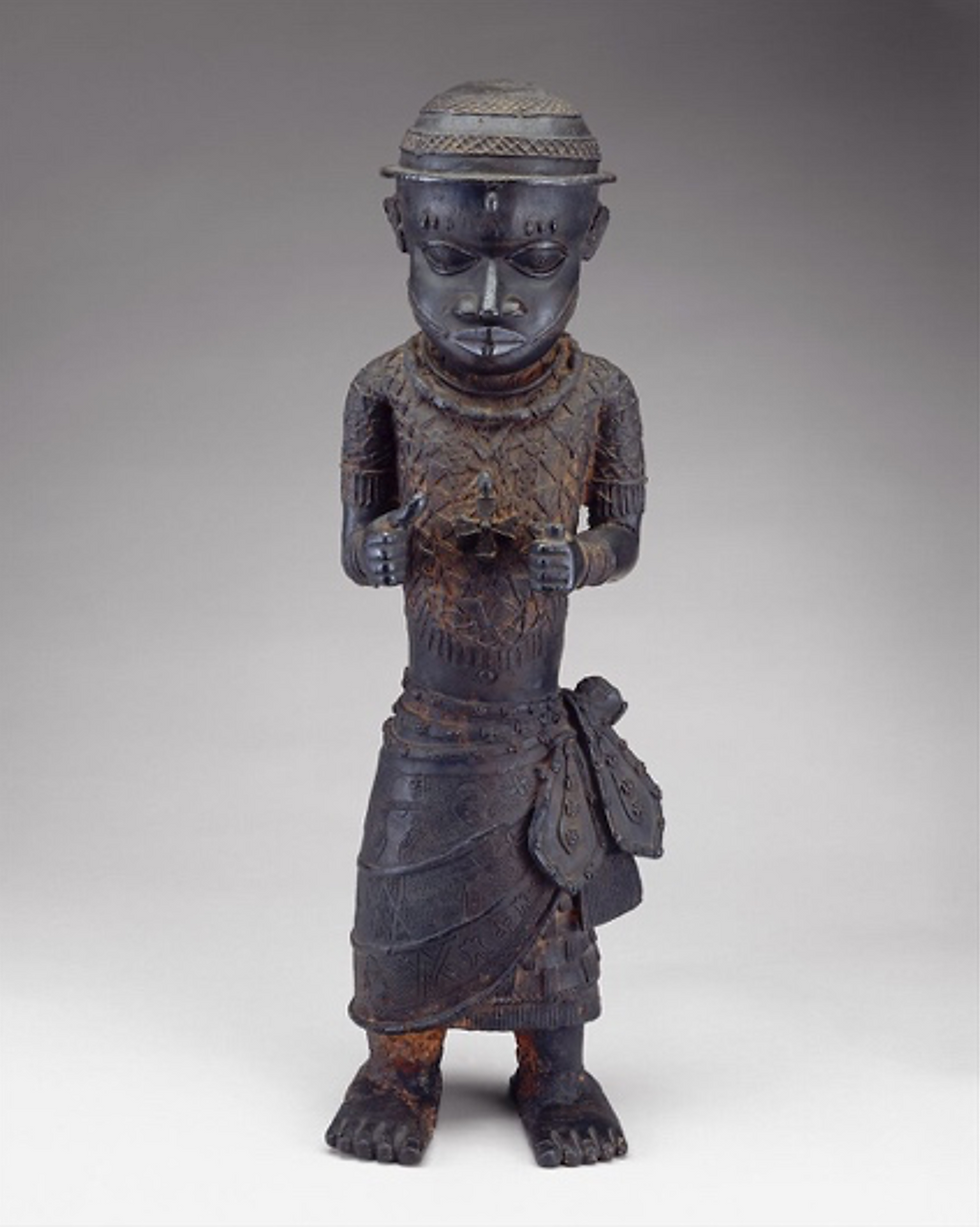
Figures 7-9 (top to bottom). Plaque with Warrior and Attendants (1990.332), commemorative brass head of an oba (1979.206.86), Court official from a commemorative altar (1991.17.32) (The Met, 2025).
A key example is the Plaque with Warrior and Attendants (Figure 7). The online exhibition text details its original location on the wooden pillars of the royal palace in Benin City, in addition to emphasising the relational nature of the plaques, stating that they “told complex narratives in relationship to one another”, even suggesting that they may have functioned as a visual archive used to resolve disputes concerning court protocol (Metropolitan Museum of Art, 2025a). Strongly emphasising on hierarchy and symbolism, this places the object back within an active political and mnemonic system from Edo culture, rather than representing it as merely an aesthetic artefact. For example, the Museum’s entry elaborates on the warrior chief’s position in the political hierarchy through his regalia, such as coral beads, leopards, and ceremonial weapons. It also explores the social meaning of fans, trumpets, and kola nuts in the Bronze, which were objects carried by the attendants. By reinforcing the idea that for the Edo people, status and authority were communicated visually through material culture, this narrative presents Benin material culture as meaning-making vehicles on bot political, ritual, and ideological levels. Similarly, when describing the commemorative brass head of an oba (Figure 8), the Met emphasises on Edo beliefs such as kingship and ancestry, which shows the wider significance of the head. According to the museum, such heads used to be placed on royal altars, which symbolise a shared source of knowledge, authority and destiny across generations (Metropolitan Museum of Art, 2025b). Instead of focusing on the technicalities of production process, which risks to reduce the interpretation to the object as a piece of art rather than material culture, the Met explains about the symbolism of materials, especially coral and brass, and their association with wealth, spiritual protection, and the sea deity Olokun. This emphasis on indigenous world view makes the Met’s presentation different from displays that prioritise form over function, as seen in the British Museum. The Met also reflects on European presence within Edo symbolism, seen in its display of a Court Official from a Commemorative Altar (Figure 9). The museum’s online catalogue explains, from different schools of thought, about how Portuguese images are included in Benin art, especially on garments and regalia, which probes into multiple possible interpretations of the object’s identity (Metropolitan Museum of Art, 2025c). This shows how the Met successfully incorporate different perspectives and the uncertainty about Benin’s complex political and religious structures.
Most significantly, the Met does not overlook the importance of colonial violence in understanding the Benin collections. Its gallery text, titled The Legacy of Benin Court Art: From Tragedy to Resilience, explicitly explains the 1897 British invasion, which led to the plundering of the palace and the exile of Oba Ovonramwen. The text links the collections to colonial conquest by solemnly reflecting on how the violent dispersal of objects “forever decoupled” them from their original cultural context. The museum also actively traces the journey that objects went through, which contributes to its post-Benin ‘social life’, such as at art markets and ethnographic museums. To continue the objects’ engagement with source communities, the Met explains current plans for using the Bronzes as ‘ambassadors’ of Edo culture globally, connected with a new museum in Benin City designed by David Adjaye. Nevertheless, by suggesting that the objects arrived at the Met through donations in 1969 and 1991, it still creates a sense of distance between the institution and the initial act of looting.
Discussion & Analysis
We have already established that Edo society never conceived Benin Bronzes as standalone art objects. Instead, they had important social and political functions: not only do they symbolise the sacredness of the Oba, who derive his authority from divine connections, they also as mnemonics that sustain historical memory and thus legitimacy within the Kingdom (Ben-Amos, 1995; Dark, 1982). In other words, brass heads, plaques, and altar figures derive value and meaning from their social context, instead of their inherent artistic nature. When the British expedition removed from palace architecture, ancestral shrines and ceremonies, this connection was severed. By contrast, the western museum mode of display thrive on isolating objects from these organic, growing social systems; otherwise it would not be able to categorise, classify and interpret their timeless aesthetic value when its social value is ever-evolving. Even when attempted to re-contextualise through giving background information on exhibition labels, museums are still merely tracing the past rather than situating the Bronzes in the present. As demonstrated in the case studies, Benin works are categorised as “African art” or “world art.” They are framed in institutions that prioritise visual analysis, evaluate their craftsmanship and stylistic significance. Although museums increasingly acknowledge ritual function and political symbolism, these explanations are delivered through curatorial text rather than social practice. The source communities are not actively engaged in the curation and re-interpretation. The objects are not ritual ‘reactivated’ in the absence of Edo spatial features, which means that the original Edo meaning is merely translated rather than transmitted. Worse, certain aspects of Edo meaning, such as the ongoing spiritual value and their role in active communication with ancestors, are largely absent from museum labels. This shows how western museums portray Benin culture as something that can be fully understood through explanation, rather than something that must be lived, practiced, or controlled by source communities. Rather than empowering Edo voices, ritual specialists, and royal authorities to shape the interpretation, they were only referenced and as a result marginalised as historical actors. This strongly support Clifford’s argument that by assuming interpretive authority over Benin objects, western museums act as primary site of knowledge production which perpetuate colonial representation.
Conclusion
In conclusion, both British Museum and the Met demonstrate that western museums still perpetuate colonial representations of African material culture to a significant, although not absolute extent. It is mainly because they chose to view the material culture as a work of art, thereby downplaying the underlying ethnographic meanings of the Bronzes such as Edo cosmology and ritual practices. In addition to the exhibition labels, their arrangement in the exhibition space also serve to disconnect and decontextualise the objects. Informed by Clifford and Said, we can see that the failure to fully embrace decolonisation of the museum space could be attributed to structural reasons, that is the need to conform to western display traditions. Nevertheless, it is clear that museums have started changing and realising the importance of connecting their collections with source communities. Although museums started to demonstrate increased reflexivity, the Benin Bronzes remain embedded within a western structure and system of display that is shaped by colonial history. Therefore, it can be said that western museums both challenge and reproduce colonial legacies, which makes them deeply ambivalent instead of wholly progressive or regressive.
References
Ben-Amos, P. (1980). The art of Benin. Thames and Hudson.
British Museum. (n.d.). The Benin Bronzes. British Museum.https://www.britishmuseum.org/about-us/british-museum-story/contested-objects-collection/benin-bronzes
Clifford, J. (1988). On collecting art and culture. In The predicament of culture: Twentieth-century ethnography, literature, and art (pp. 215–251). Harvard University Press.
Dark, P. J. C. (1973). An introduction to Benin art and technology. Clarendon Press.
Gunsch, K. W. (2020). The Benin Plaques: A 16th-century imperial monument. Routledge.
Hicks, D. (2020). The brutish museums: The Benin Bronzes, colonial violence and cultural restitution. Pluto Press.
Lonetree, A. (2009). Museums as Sites of Decolonization: Truth Telling in National and Tribal Museums. In: Sleeper-Smith, S. (ed.). Contesting Knowledge: Museums and Indigenous Perspectives. Lincoln and London: University of Nebraska Press, pp. 322-338.
McEwan, O. (2021, June 29). How the labels in the British Museum’s Africa galleries evade responsibility. Hyperallergic.https://hyperallergic.com/british-museum-africa-galleries-labels-evade-responsibility/
Metropolitan Museum of Art. (n.d.). Collection search: Benin Bronzes.https://www.metmuseum.org/art/collection
Onciul, B. (2015). Museums, Heritage and Indigenous Voice: Decolonising Engagement. New York: Routledge.
Phillips, B. (2021). Loot: Britain and the Benin Bronzes. Oneworld Publications.
Said, E. W. (1978). Orientalism. Pantheon Books.
Wood, P. (2012). Display, Restitution and World Art History: The Case of the ‘Benin Bronzes.’ Visual Culture in Britain, 13(1), 115–137.

Comments